 Service 01
Terrace Waterproofing
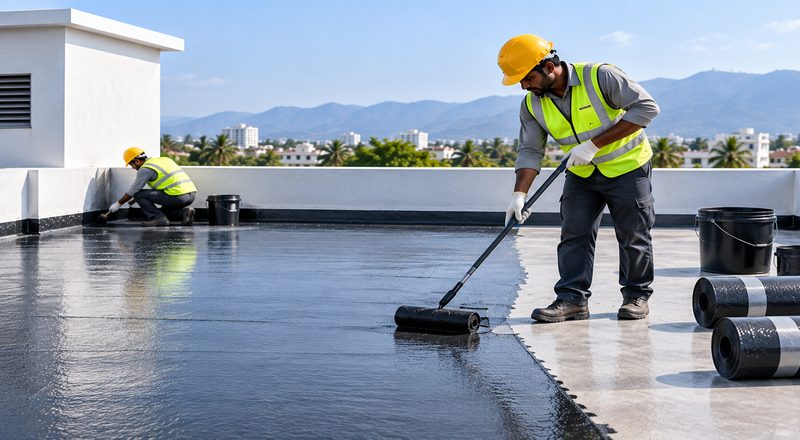
Exposed terrace slabs treated after slope correction, crack routing and parapet detailing — the most common leak source we are called to.

Fourteen waterproofing systems covering every part of a structure that meets water — from an exposed terrace slab to a lift pit three levels below ground.
Our three disciplines
Services
Water finds the weakest detail, not the biggest surface. Our survey starts at the junctions — parapets, drains, pipe penetrations and construction joints — because that is where most leaks begin.
Service 01Exposed terrace slabs treated after slope correction, crack routing and parapet detailing — the most common leak source we are called to.
 Service 02
Sloped roofs, mumty areas and roof gardens, with membrane or liquid-applied systems chosen for the exposure and foot traffic.
 Service 03
Positive and negative side treatment for basements, lift pits and sumps, including active-leak arrest before coating.
 Service 04
Blindside and back-filled walls with bituminous membrane or PU coating, protection board and construction joint sealing.
 Service 05
Landscape podiums and deck slabs with root-resistant membrane, drainage layer, filter fabric and protective screed.
 Service 06
Sunk portions, shafts and balconies in polymer-modified cementitious coating with fillet coving, pipe collars and a 48-hour ponding test.
 Service 07
Pool shells, balancing tanks and surrounds treated with systems that stay flexible under permanent water load.
 Service 08
Underground sumps and overhead tanks lined with potable-water-safe systems, certified where the application requires it.
Systems
There is no single best waterproofing product. There is a correct match between the substrate, the exposure, the movement and the budget.
Backer rod and sealant systems for expansion and construction joints in slabs, walls and podiums.
PU and epoxy resin injected under pressure into live cracks and construction joints to stop water at source.
Reinforced bituminous membrane, torch applied, for large exposed terraces and podiums needing a heavy-duty barrier.
Seamless liquid-applied polyurethane with high elongation and UV stability, for terraces with movement and complex detailing.
Elastomeric acrylic coating for exposed roofs and external walls. Reflective, breathable and economical.
Two-component polymer-modified slurry for wet areas, tanks, sumps and internal surfaces.

Why leaks come back
In nine out of ten repeat-leak sites we inspect, the previous coating was applied over a dusty, damp or unprimed surface, or the water was never given a slope to leave by.
FAQ
It depends on the system and the surface preparation. A properly laid APP membrane with protective screed typically performs for ten years or more, a good PU coating for seven to ten years, and an acrylic coating for four to six. Any of them fails early if the slope is wrong or the parapet junctions were skipped.
Injection grouting and crystalline treatment can be carried out on damp substrates. Membrane and coating systems need a dry, cured surface, so those are scheduled before or after the rains.
We diagnose first. Sometimes water enters at a single parapet junction or pipe penetration well away from where the ceiling is wet. Where the slab has cracked across the surface, spot repairs simply move the leak.
A written warranty is issued on completion. The term depends on the system specified and is stated on the quotation before you place the order.
Free site inspection
Send a photograph on WhatsApp and we will tell you what we think it is, then confirm it on site free of cost.